If you’re working on geometry problems that involve resizing shapes like maps, blueprints, or model figures you’re probably dealing with scale factor word problems. These aren’t just classroom exercises. They help you understand how real-world objects relate to their scaled versions, whether you’re shrinking a building design onto paper or blowing up a tiny cell under a microscope.
What does “scale factor” actually mean in these problems?
Scale factor is the number you multiply by to go from one version of a shape to another. If you’re told a rectangle is enlarged by a scale factor of 3, every side becomes three times longer. If it’s reduced by 0.5, everything gets cut in half. Simple enough but word problems add context, like comparing a photo to its poster-sized print or figuring out the size of a toy car based on the real thing.
When will I actually use this outside class?
You’ll see scale factor thinking in architecture, engineering, even cooking (scaling recipes up or down). In geometry class, you’re practicing proportional reasoning the kind of math that helps you check if two shapes are similar, predict missing measurements, or verify if a drawing matches its description. It’s less about memorizing formulas and more about spotting relationships between sizes.
What do these problems usually look like?
A typical question might say: “A triangle has sides 4 cm, 6 cm, and 8 cm. After dilation, the longest side is 20 cm. What’s the scale factor?” You’d divide 20 by 8 to get 2.5. That’s your multiplier for all sides. Another might ask you to find an original length after being told the scaled version and the factor. Sometimes they throw in area or volume, which change by the square or cube of the scale factor not the same as side lengths.
Where do students usually trip up?
- Confusing scale factor with area or volume scaling. If sides double, area quadruples. Always check what the question is asking for.
- Assuming the factor is always greater than 1. Reductions use fractions or decimals less than 1.
- Not labeling units. Mixing inches and centimeters without converting? That’ll break your answer.
- Forgetting to apply the factor to all dimensions. A 2D shape needs both length and width adjusted. A 3D object? All three.
How can I get better at solving them?
Start by identifying what’s given and what’s asked. Draw a quick sketch if it helps. Write down the known measurements and label which is original and which is scaled. Use division to find the factor (scaled ÷ original), then multiplication to find missing values. If you’re stuck, try working through a few practice problems designed for middle school level they build confidence without overwhelming you.
What if the problem involves coordinates or graphs?
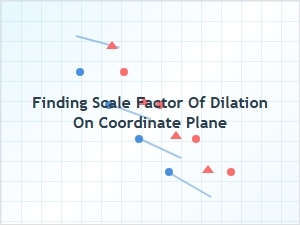
Some questions place shapes on a grid and ask you to find the scale factor after a dilation centered at the origin. The process is the same: compare corresponding points. If point A was at (2, 3) and moved to (6, 9), divide each coordinate: 6÷2 = 3, 9÷3 = 3. Scale factor is 3. For more detail on how this works visually, check out this guide on finding scale factor using coordinate planes.
Any tips for checking my work?
- After calculating, plug your scale factor back into the original measurements. Do you get the scaled values? If not, recalculate.
- If area or volume is involved, remember: area scales by factor², volume by factor³.
- Ask yourself: does the answer make sense? A scale factor of 50 for a map? Probably not. A factor of 0.1 for a model airplane? More likely.
Need more examples with full explanations? Try walking through these geometry-focused word problems they include step-by-step solutions and common pitfalls to avoid.
For deeper background on proportional reasoning in math, you can also explore this external resource: Khan Academy’s similarity and scale lessons.
Quick checklist before submitting your answer:
- Did I identify original vs. scaled measurements correctly?
- Did I use division to find the scale factor (scaled ÷ original)?
- Did I apply the factor to all relevant dimensions?
- If area or volume is involved, did I adjust for squared or cubed scaling?
- Does my final answer match the units and context of the problem?
 Practice Problems for Scale Factor Calculations
 Calculating Scale Factors for Similar Triangles
 Mastering Dilation Scale Factor Calculations
 Practical Examples for Calculating a Scale Factor
 Mastering Scale Factors with Practice Dilation Problems
 Applying Scale Factors to Shapes with Worksheets